
Cycle Common Questions
We’ve compiled answers to the most frequently asked questions about Cycle.
What is cycle length?
Cycle length is the number of days from the first day of one period to the day before your next period.
What is period length?
The number of consecutive days you bleed during your period.
How long is a normal cycle?
Most cycles last 24–38 days, with an average of 28 days. A typical cycle is often referred to as 28 days, but this varies from person to person and can change with age.
Short: < 24 days
Normal: 24–38 days
Long: > 38 days
How long is a normal period?
A normal period can last between 2–8 days. A typical period is around 5 days, but this varies from person to person and by age.
Short: < 2 days
Normal: 2–8 days
Long: > 8 days
What is cycle variability?
Cycle variability is how much your cycle length changes from month to month.
A regular cycle variability is:
± 4 days for ages 26–41
± 5 days for ages under 26 or 42–45
Variability outside of these ranges is considered irregular.
What impacts cycle variability?
Cycle length can change naturally from month to month. Factors like stress, sleep, travel, illness, intense exercise, or weight changes can all affect hormone timing. Age, thyroid conditions, reproductive conditions, and coming off hormonal contraception can also contribute to variability.
When should I log spotting vs. flow?
If your flow is inconsistent, meaning it happens randomly throughout the month or only part of the day, log it as spotting. If your flow is consistent over a few days, this is likely your period.
If you're experiencing consistent irregularity, extremely heavy flow, or an absence of flow, it's a good idea to consult your doctor.
What are period predictions based on?
Based on your past 6 cycles of data, we predict your cycle length, period length, and ovulatory phase. If you have fewer than 6 cycles, we use what is available, although predictions may not be as accurate.
How is the ovulatory phase detected?
We estimate the ovulatory phase based on temperature patterns. Specifically, we look for a sustained shift from below your baseline temperature to above your baseline.
Studies have shown that wrist temperature can predict ovulation with approximately 90% accuracy.
If no temperature trends are detected, the ovulatory phase is estimated between 10–14 days before the end of your cycle, depending on your historical patterns.
What is regular vs. irregular cycle variability?
A regular cycle variability is:
± 4 days for ages 26–41
± 5 days for ages under 26 or 42–45
Anything outside of these ranges is considered irregular.
How accurate are the predictions if my cycle is irregular?
Bevel predicts cycles using the median of your past 6 periods. If your cycles are highly irregular, predictions may not be highly accurate.
The app predicted my period wrong, how do I correct it?
The more cycle data we have, the better we can predict your period. Predictions are based on the median period and cycle lengths from up to your past 6 periods. Continuing to log your cycles will improve accuracy over time.
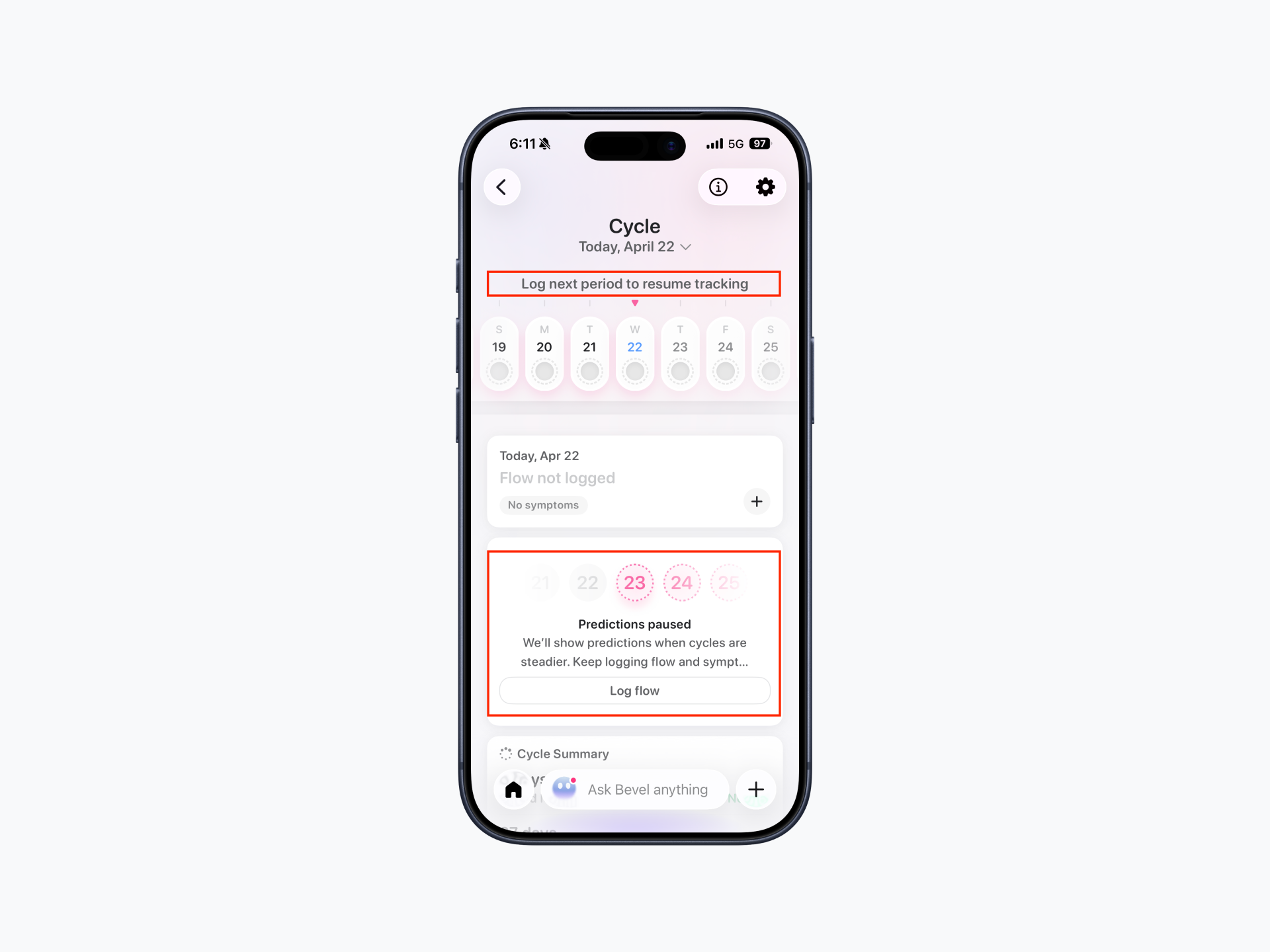
Why are my period predictions paused?
Predictions will be paused if you haven't logged flow in a while, or if we detect large irregularities and cannot confidently predict your next cycle. Continue logging flow to restore predictions.
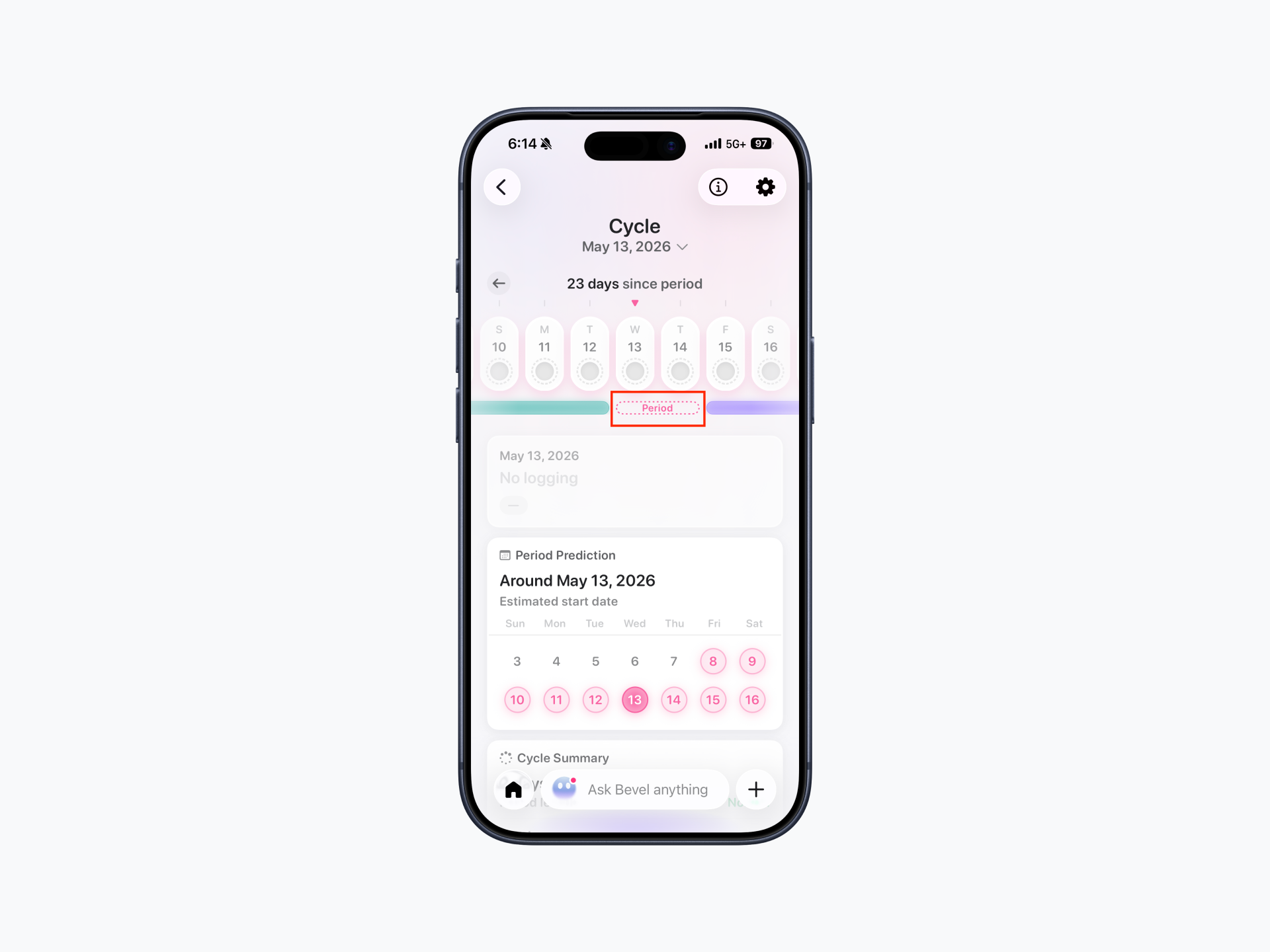
What does the dotted period bar mean?
Your period window is estimated from your cycle and period length.
What does the dotted ovulatory phase bar mean?
This indicates a low-confidence ovulatory phase. This usually appears when there is limited data and Bevel cannot predict ovulation with high confidence.
What cycle phases does Bevel track?
A typical natural cycle is divided into the follicular and luteal phases, separated by ovulation. Bevel further distinguishes this into four phases for more granular insights:
Menstrual
Follicular
Ovulatory
Luteal
What happens during my period (menstrual phase)? How does Bevel track or predict this?
What happens: The uterine lining (endometrium) is shed, resulting in menstrual bleeding.
Hormones: Estrogen and progesterone are low. FSH begins to rise to recruit new follicles.
How the phase is determined in the app: Based on user-logged flow days and predicted over time with sufficient cycle data (typically 6 cycles).
What happens during my follicular phase? How does Bevel track or predict this?
What happens: Follicles grow in the ovary, and one becomes dominant. The uterine lining thickens again.
Hormones: Estrogen rises steadily. FSH is elevated early, then declines. LH rises slightly.
How the phase is determined in the app: This phase is defined as the time after your period and before ovulation.
What happens during my ovulatory phase? How does Bevel track or predict this?
What happens: A surge in luteinizing hormone (LH) triggers the release of an egg (ovulation).
Hormones: Estrogen peaks just before ovulation, triggering the LH surge. Progesterone begins to rise slightly.
How the phase is determined in the app: If temperature data is available, we use the point where your temperature shifts from below to above your baseline.
If temperature data is not available, we estimate ovulation by subtracting a typical luteal phase length (around 14 days) from your cycle length.
What happens during my luteal phase? How does Bevel track or predict this?
What happens: The corpus luteum forms and secretes progesterone, preparing the uterus for possible implantation. If no pregnancy occurs, hormone levels drop and the next period begins.
Hormones: Progesterone is high (peaking mid-luteal). Estrogen has a secondary rise, then both drop if no fertilization occurs.
How the phase is determined in the app: This phase is defined as the time after ovulation and before your next period. It typically lasts 10–14 days.
What are the key hormones in the menstrual cycle?
Follicle-Stimulating Hormone (FSH): Helps stimulate follicle growth early in the cycle and supports the selection of an egg. Stimulated by the anterior pituitary gland.
Luteinizing Hormone (LH): Triggers ovulation and supports the luteal phase (the second half of your cycle after ovulation). Stimulated by the anterior pituitary gland.
Estrogen: Builds up the uterine lining and supports egg growth, peaking just before ovulation. Think of this as “the builder.”
Progesterone: Stabilizes the uterine lining after ovulation to support a potential pregnancy, then drops if no pregnancy occurs. Think of this as “the protector.”
What is a natural cycle?
In a natural menstrual cycle, your hormones rise and fall in a predictable pattern. Estrogen increases leading up to ovulation, a surge in luteinizing hormone (LH) triggers ovulation, and progesterone rises afterward to support a potential pregnancy.
What is hormonal birth control?
Hormonal birth control provides steady levels of synthetic hormones that suppress follicle-stimulating hormone (FSH) and luteinizing hormone (LH), which prevents ovulation. This flattens your natural estrogen and progesterone fluctuations.
As a result, energy and symptoms may feel more stable overall. However, some people notice less of the natural increase in energy that can occur around ovulation.
If you stop taking hormonal birth control, it’s normal for your body to take some time to return to its natural hormone patterns.
Do you still get a period on contraception?
Most hormonal birth control stops ovulation, so what looks like a period is actually called withdrawal bleeding. It happens because your hormone levels drop temporarily, causing your uterus to shed a small amount of lining.
It is not a true period since you did not ovulate, but it can look and feel similar. Bevel does not predict withdrawal bleeding days.
Why are my phases hidden?
When on hormonal contraception, ovulation does not occur, so you do not go through the typical phases of the menstrual cycle. Any bleeding is considered withdrawal bleeding, which Bevel does not predict, but you can still track.
What happens if I log hormonal contraceptives in Bevel?
Logging hormonal contraceptive use adjusts your cycle view to display only withdrawal bleeding days. This reflects how hormonal contraceptives work: they suppress or stabilize your body's natural hormone fluctuations.
Bevel does not predict withdrawal bleeding days.
Should I still log symptoms while on contraceptives?
Yes. Hormonal contraceptives suppress your natural cycle, but you may still notice changes in mood, energy, or physical symptoms from synthetic hormones. Logging helps track your patterns and provides continuity if you stop using contraception.
How do predictions change on contraceptives?
When you log hormonal contraception, Bevel hides period and cycle predictions since these can be irregular or artificially altered by the hormones. You will only see withdrawal bleeding days.
Can I track non-hormonal contraception?
Yes. You can log non-hormonal methods such as condoms, diaphragms, or copper IUDs under “Other (non-hormonal)". These do not affect your natural hormone cycle, so Bevel continues to show all phases and predictions.
Can I switch back to natural cycle tracking later?
Yes. If you stop using hormonal contraception, simply end it in Bevel. Your cycle view will return to natural tracking, and Bevel will begin recalculating your phases as your body resumes its natural rhythm, which may take a few cycles.
How do I add a missed or past period?
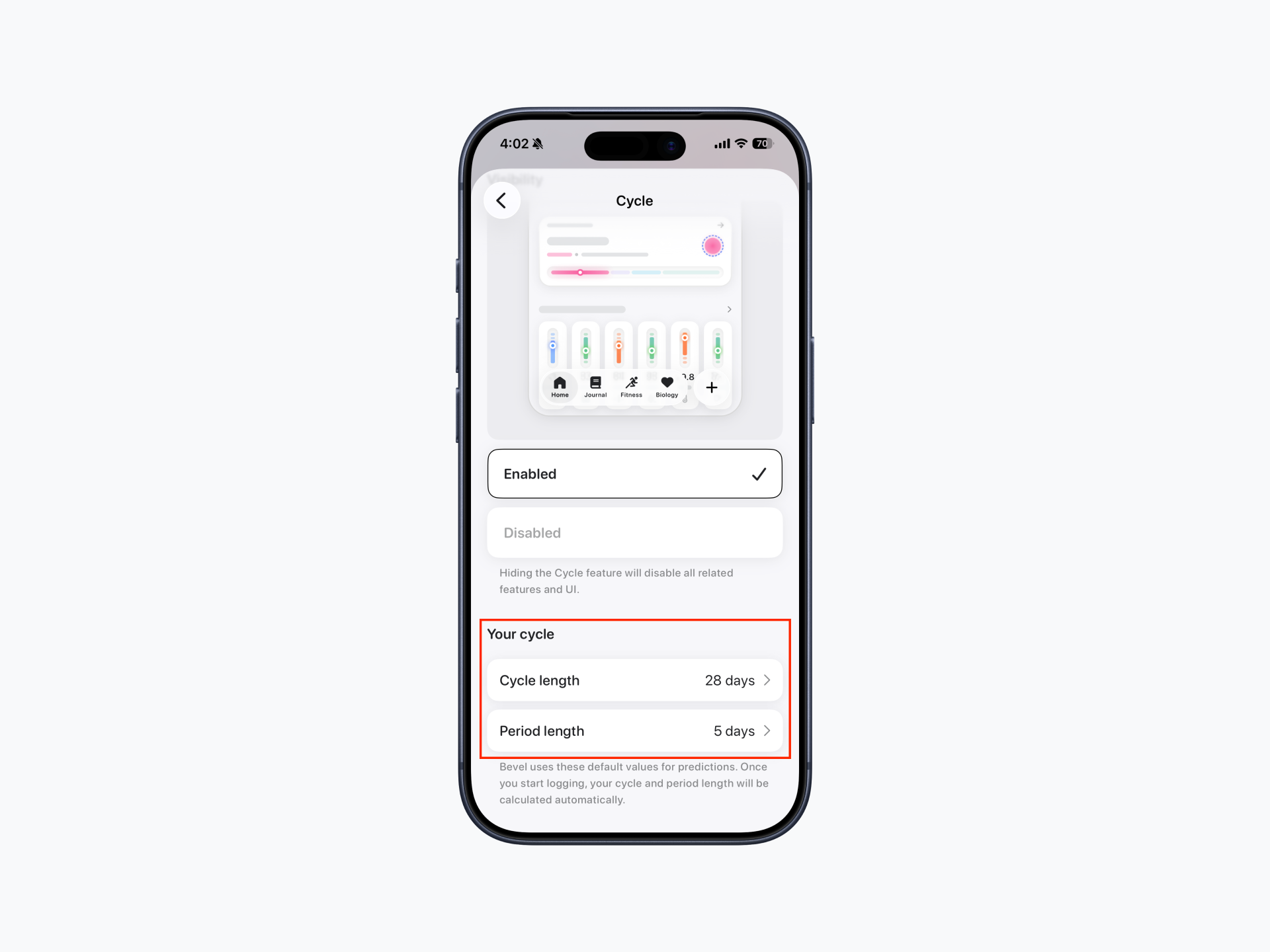
You can log previous periods by scrolling back in time and pressing the plus button, or from the Calendar.
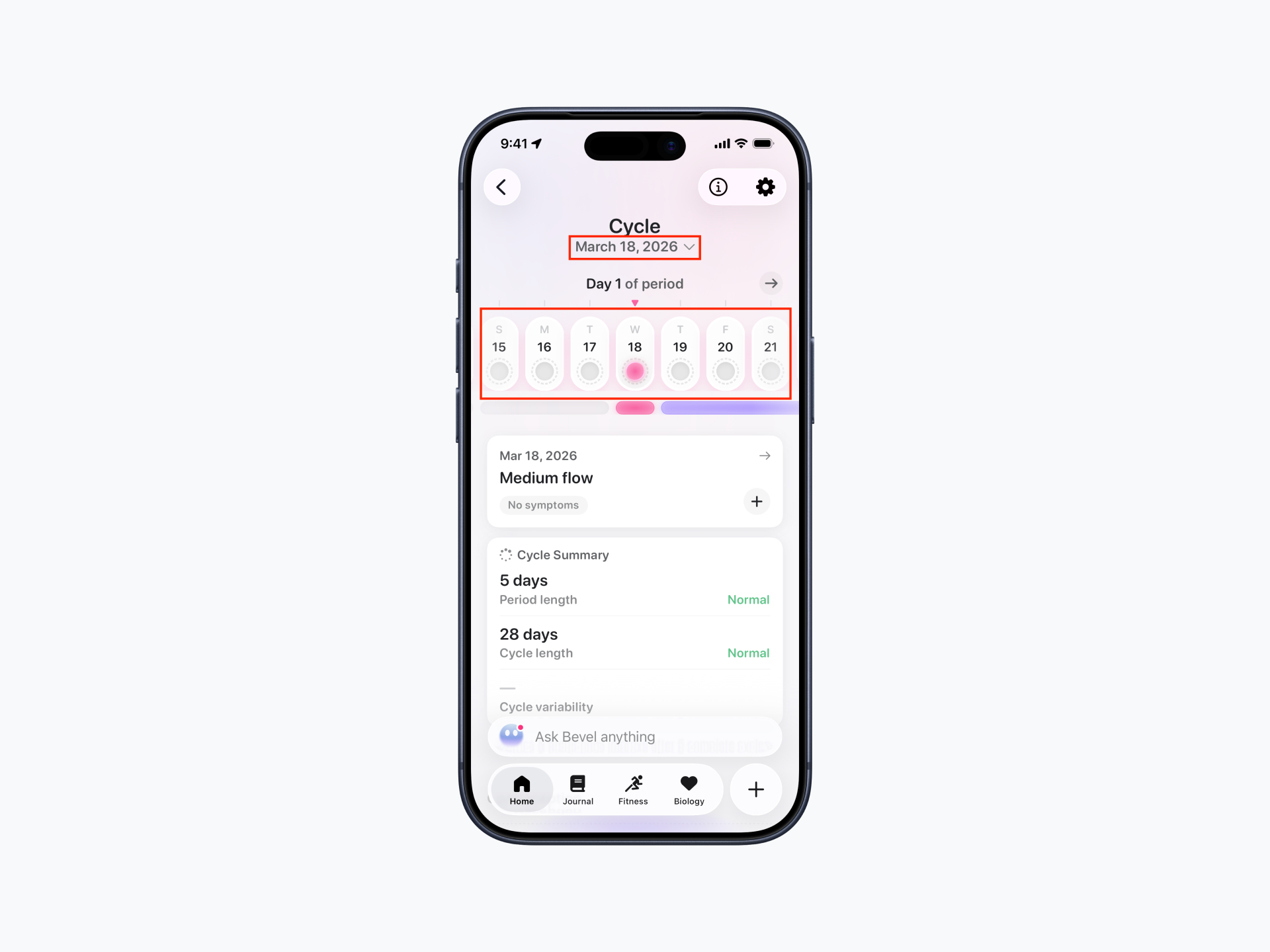
Where can I edit my average cycle length or period duration?
In Cycle Settings, you can edit your default cycle length and period duration. However, as Bevel learns your cycles over time, it will use those variations for predictions. Defaults are only used when there is not sufficient data.
To navigate to Cycle Settings, select Cycle from the Home page, then tap the Settings icon in the top-right corner.
Can I see trends over time or export my cycle history?
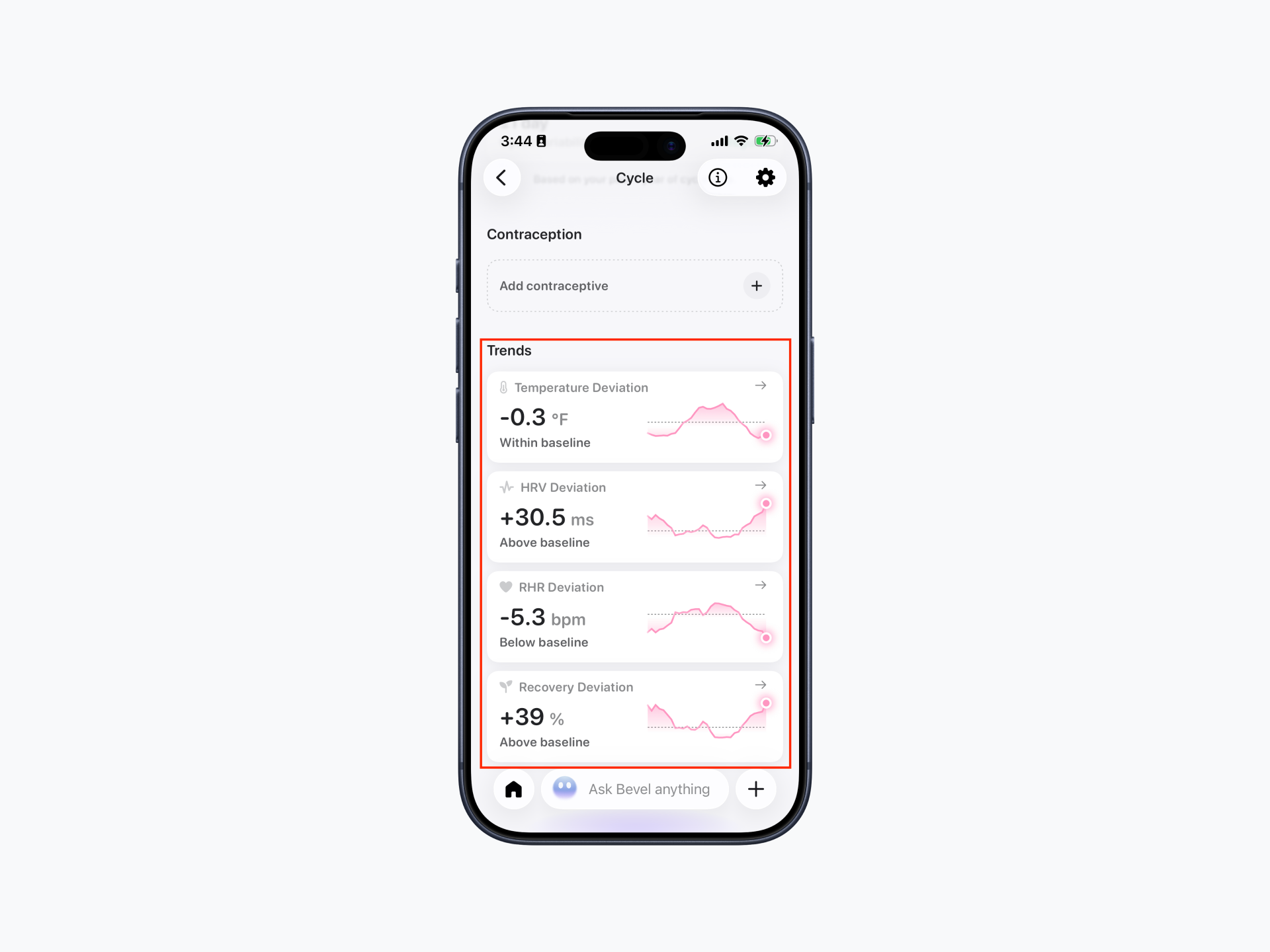
You can see trends in Temperature, Resting Heart Rate, Heart Rate Variability, and Recovery deviations under Trends on the Cycle Tracking page.
Since all data is written to Apple Health, you can export directly from Apple Health.
Can I import data from another period tracking app?
This is not available at the moment. However, if you logged in an app that synced to Apple Health previously, Bevel will seamlessly read that data.
Where can I find my cycle history with dates, cycle lengths and period lengths?
You can see these visually in the Cycle Tracking calendar, however there is currently no list of these values.
How do I get notifications before my next period?
This is not available at the moment.
How does stress affect the period?
Stress raises cortisol levels, which can disrupt the hormones that control your menstrual cycle.
Specifically, it can interfere with the brain’s release of gonadotropin-releasing hormone (GnRH). This disrupts downstream hormones, luteinizing hormone (LH) and follicle-stimulating hormone (FSH), that control estrogen and progesterone production, leading to changes in ovulation and menstrual timing.
Why does my weight fluctuate during the menstrual cycle?
Weight fluctuates due to hormonal changes, especially increases in estrogen and progesterone. These changes can cause water retention, bloating, and temporary increases in appetite or digestion changes.
These effects usually resolve after menstruation begins.
What is cycle syncing?
Cycle syncing is the practice of adjusting your workouts and nutrition based on your menstrual cycle.
While some studies detect differences in physiological measures between phases, these effects are often modest and vary widely between individuals. What works for one person may not work for another.
Should I sync my workouts to my cycle?
The science shows that there’s no one-size-fits-all formula. You should train based on your individual experience and symptoms.
However, it is common to notice higher energy during the follicular phase and lower energy during the luteal phase.
How should I adjust my Fitness / Strain during each phase?
Period: If you’re in pain or low on energy, focus on gentle movement like walking, yoga, or stretching. If you’re feeling good, this can still be a strong time for intense workouts. Your body tolerates heat and carbohydrates well, which can support performance.
Follicular: Ideal for high-intensity training and resistance work. You may find it easier to build strength or try new workouts.
Ovulatory: Ideal for high-intensity training and peak performance. Estrogen supports faster recovery and greater muscle activation.
Luteal: Adjust based on symptoms.
Early luteal: higher heart rate, body temperature, and energy expenditure
Late luteal: lower energy and mood; focus on recovery and gentle movement
How should I adjust my Nutrition during each phase?
Most importantly, aim for a consistent, balanced diet throughout your cycle. Small adjustments can help support how your body feels in each phase.
Period: Focus on iron-rich foods (like leafy greens, lentils, or red meat), along with healthy fats and balanced carbohydrates to support energy and recovery.
Follicular: You may feel lighter and more energized; fresh, lighter meals and lean proteins can feel good during this phase.
Ovulatory: Prioritize hydration and nutrient-dense foods, especially fruits, vegetables, and whole foods that support overall energy.
Luteal: Warm, grounding meals can feel more satisfying. Magnesium-rich foods (like dark chocolate, nuts, and leafy greens) may help with cravings and PMS symptoms.
How should I adjust my Sleep during each phase?
Sleep needs and quality can shift slightly throughout your cycle, so it helps to stay consistent while adjusting where needed.
Period: Prioritize rest and allow for more sleep if you’re feeling fatigued.
Follicular: Sleep is often more efficient; maintain a consistent routine and take advantage of stable energy levels.
Ovulatory: Sleep quality is typically strong, but make sure you’re fueling enough to support higher activity levels.
Luteal: Sleep may feel lighter or more disrupted. Keeping your bedroom cool, limiting caffeine, and sticking to a routine can help.
How should I adjust my Recovery during each phase?
Recovery needs can change across your cycle, so it’s helpful to adjust based on how your body feels.
Period: Use warmth (like heating pads or warm showers) to help with discomfort and support recovery.
Follicular: Your body often recovers more quickly; this can be a good time to increase training load if you feel up to it.
Ovulatory: Recovery efficiency is typically high. You may feel ready for more intense or demanding sessions.
Luteal: Your body may feel warmer and slightly more strained. Cooling strategies and prioritizing rest can help support recovery.
What are typical symptoms during each phase?
Everyone’s experience is different, but these are common patterns you may notice:
Period: Cramping, fatigue, bloating, headaches, and lower mood or motivation.
Follicular: Rising energy, improved mood, clearer thinking, and better exercise performance.
Ovulatory: Higher energy, confidence, and social engagement. Some people also notice increased libido.
Luteal: Bloating, breast tenderness, fatigue, mood swings, and irritability (often referred to as PMS).
How does my cycle data compare to the average population of the same age?
Based on a Natural Cycles study with data from more than 600,000 menstrual cycles.
Cycle Length by Age
Age Range | Average | Min | Max |
18–24 | 30 days | 25 | 36 |
25–29 | 30 days | 24 | 36 |
30–34 | 29 days | 24 | 34 |
35–39 | 28 days | 24 | 33 |
40–45 | 27 days | 23 | 32 |
All ages | 29 days | 24 | 35 |
Period Length by Age
Age Range | Average | Min | Max |
18–24 | 4 days | 3 | 6 |
25–29 | 4 days | 3 | 6 |
30–34 | 4 days | 2 | 5 |
35–39 | 4 days | 2 | 5 |
40–45 | 4 days | 2 | 5 |
All ages | 4 days | 2 | 6 |
Follicular Phase Length by Age
Age Range | Average | Min | Max |
18–24 | 18 days | 12 | 24 |
25–29 | 18 days | 12 | 23 |
30–34 | 17 days | 12 | 22 |
35–39 | 16 days | 11 | 20 |
40–45 | 15 days | 10 | 19 |
All ages | 17 days | 12 | 22 |
Luteal Phase Length by Age
Age Range | Average | Min | Max |
18–24 | 12 days | 10 | 15 |
25–29 | 12 days | 10 | 15 |
30–34 | 12 days | 10 | 15 |
35–39 | 12 days | 10 | 15 |
40–45 | 12 days | 10 | 15 |
All ages | 12 days | 10 | 15 |
Cycle Variation by Age
Age Range | Average | Min | Max |
18–24 | 3 days | 1 | 6 |
25–29 | 3 days | 1 | 6 |
30–34 | 3 days | 1 | 5 |
35–39 | 2 days | 1 | 4 |
40–45 | 2 days | 0 | 5 |
All ages | 3 days | 1 | 5 |
Can I track birth control, ovulation test results, fertility, menopause, peri-menopause or pregnancy?
Not currently. The main purpose of Cycle Tracking right now is to track flow and symptoms, understand patterns in your cycles, and provide insights relating to your Sleep, Nutrition, Fitness and more.
Is there a way to track a condition like Endometriosis, PCOS, PMDD, Thyroid Disorders, etc?
Not directly. You can log symptoms associated with these conditions and share them with Bevel Intelligence for context.
Is there a way for me to confirm my ovulation days with LH tests?
Not at the moment. Bevel uses temperature trends to estimate ovulation, and there is currently no way to override it.
Where are your period/cycle/phase statistics sourced from?
Bevel Cycle Tracking is informed by research from the Apple Women’s Health Study with the Harvard School of Public Health and the International Federation of Gynecology and Obstetrics (FIGO).
How secure is my reproductive health data?
All reproductive health data, including flow, contraception, and symptoms, is stored securely in Apple Health. Bevel does not store reproductive data on our servers and never sells your information.
You can view or delete your data anytime through Bevel Settings or Apple Health. If you enable Reproductive Health in Bevel Intelligence Settings, only the necessary data is accessed to support your insights.
You can review our full privacy policy here.
Important Disclaimer
Bevel Cycle Tracking is a wellness feature, not a medical device. It should not be used for conception, contraception, or diagnosing conditions.
All cycle phases, including ovulation, are estimates. Always consult a medical professional for health concerns.